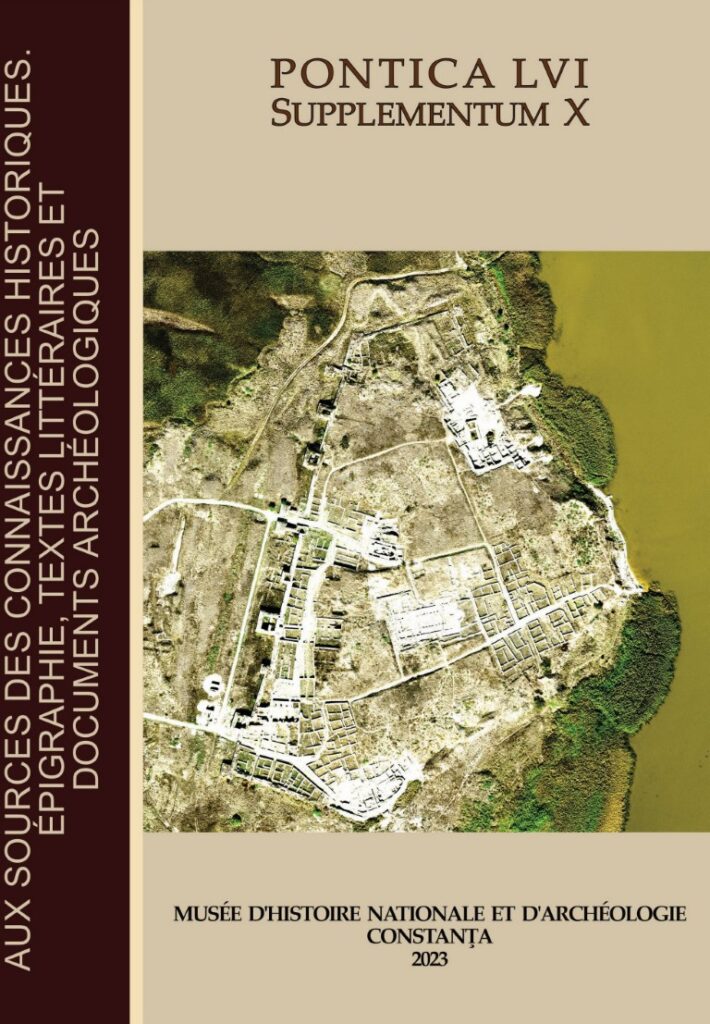
Pontica No. 56 Supplementum X (2023)

ALEXANDRU AVRAM

Le milieu scientifique roumain et international a été consterné par la disparition du professeur Alexandru Avram, en août 2021, sur le chantier d’Istros, cet endroit si cher à son cœur depuis 1977, lors de sa première participation aux fouilles, en tant qu’étudiant. Modelé dans le cadre de l’école archéologique roumaine, digne disciple du grand épigraphiste D. M. Pippidi, Alexandru Avram a témoigné de sa valeur intellectuelle et scientifique dans plusieurs domaines de l’histoire : l’épigraphie, l’archéologie et l’histoire des colonies grecques de la mer Noire ; l’épigraphie et l’archéologie de l’Asie Mineure ; épigraphie phrygienne ; les timbres amphoriques grecs ; les accords de Rome avec les colonies hellénistiques. Son activité scientifique et didactique s’est déroulée également en Roumanie qu’en France, en tant que chercheur à l’Institut d’Archéologie „Vasile Pârvan” de l’Académie Roumaine et professeur à l’Université de Bucarest et, ultérieurement, à l’Université du Mans. Il a ainsi soutenu, dans son domaine de compé- tences, la connexion entre les sciences historiques roumaines et internationales.

DE NOUVEAU SUR LE KÉRAMARQUE DES TIMBRES AMPHORIQUES THASIENS

The author discusses the title κεραμάρχης occurring on Thasian stamps under the magistrate Pythion I (c. 337 BC). The word κεραμάρχης being inserted in the stamps’ legends between the producer’s name (Anphikrates, Megakleides or Pylades) and the magistrate’s name, it is difficult to decide to whom of them it refers. Contrary to the prevailing orthodoxy (even if sometimes rejected, e.g. Börker 1998: 15–17; Börker 2019: 79– 80), the author argues that this title does not refer to the potter but to the magistrate. He briefly discusses the meaning of Greek compounds ending in -αρχης, – αρχος and admits that they refer to officials or quasi officials. On the other hand, all Pythion I’s stamps use as device the famous Thasian parasemon (Heracles archer) occurring not only on several amphorae but also on silver coins of the same period; thus, we would expect through κεραμάρχης a reference to the magistrate rather than to the potter. Moreover, the main argument in the same direction is a stamp (note 16) where the producer’s name stands in genitive; therefore, it cannot be related to the nominative κεραμάρχης that follows.

Alexandru AVRAM

WHAT ARE EIONES IN ANCIENT DESCRIPTIONS OF THE NORTHERN BLACK SEA COASTS?

This paper presents an analysis of the use of the word ἠϊών in Greek literature from Homer to Byzantine time. The author reviews the many meanings of the word in various contexts and sets out the most important meaning of this in relation to low-lying seacoasts, sandbanks and peninsulas of the northern Black Sea.

Alexander V. PODOSSINOV

HELLENISTIC THRACE: A POLITICAL GEOGRAPHY

The aim of this contribution is to present a synthetic but detailed exposition of the little historical evidence regarding the kingdoms of Hellenistic Thrace. The principal kingdoms attested in Thrace during the Hellenistic period are: the Celtic kingdom with capital at Tylis (Tyle), the Odrysian residual kingdom around Seuthopolis, the kingdom of Cabyle also probably related to the Odrysian, the principality of king Sadalas, the principality of Diegylis. The evidence concerning these kingdoms is very scanty. A special focus will be made on the most important epigraphical sources related to these events: the great Seuthopolis inscription, a fragmentary decree from Apollonia Pontica in which is mentioned Cotys, the Mesembrian decree for Sadalas that is an inscription whose date remains debatable. Also interesting are the relations in this period between Thrace and the most important Hellenistic kingdoms. Military campaigns were made in Thrace by the Seleucid kings, Antiochus II Theos and Antiochus III the Great. Also very intense was the military activity in Thrace of the Ptolemaic king Ptolemy III Evergetes. Later at the end of the third century BC the decline of the Ptolemaic kingdom under Ptolemy IV made possible an intervention policy of the Antigonid king Philip V in the area. Ample space will also be reserved to the analysis of the relations between Thracian kingdoms and the Hellenistic kingdom of Bithynia. Also in this case the evidence is quite small, but are really interesting the figures of Cavarus, king of the Celtic kingdom of Thrace, who acts as a mediator in the war between Prusias I and Byzantium and of Diegylis, Thracian chieftain who helps Prusias II in the civil war against his son Nicomedes II.

Ferdinando FERRAIOLI

COMPARING THE SOURCES OF HISTORICAL KNOWLEDGE. THE SETTLEMENT AT NEO RYSIO (THESSALONIKI) ANDTHE MACEDONIAN EXPANSION TO THE EAST OF THE AXIOS

The purpose of this paper is twofold: one the one hand, it presents the results of a new systematic archaeological excavation that has been taking place since 2016 near the village of Neo Rysio, about 17 km south-southeast of Thessaloniki. The site, called “Trapeza of Neo Rysio – Kardia”, has until now yielded architectural remains and finds of several categories belonging to a settlement that was in use in Early Iron Age and the Archaic period. On the other hand, it attempts an approach to the well-known question of the time during which the regions to the East of the Axios River passed under Macedonian control. The reason for the latter is that the abandonment of the specific settlement, according to its finds so far, and the coming of the area under Macedonian control, according to the recent research, appear to have taken place in the same period.

Manolis MANOLEDAKIS

EPIGRAPHIC UPDATES ON THE KARIAN MAGNATE OLYMPICHOS AND HIS TRANSACTIONS WITH LAODIKE, WIFE OF ANTIOCHOS HIERAX

The Karian dynast Olympichos was formerly said to be of Alinda, though more likely hailed from Mylasa. He entered the historical stage by expelling Ptolemaic garrisons from Mylasa around 244 BC. He acted as an official of Seleukos II (246–225), even though the king was distant and fighting to re-establish his own royal authority in Syria. Olympichos probably acknowledged Antiochos Hierax as king, when Seleukos ceded his brother the Anatolian territories in 242. As of 227, he began to cooperate with Antigonos Doson (229–222), when this one took over Karia. Olympichos maintained his pre-eminence also under Philip V (222–179). Soon after 220, we lose his traces in the historical record, except for a recently discovered inscription, which proves that he was still honoured in the later 2nd century BC. Besides his military and economic resources, his diplomatic skills permitted him to navigate smoothly between the demands of the (not always powerful) kings and queens on the one hand and the needs of the populace on the other. The purchase of estates from queen Laodike, the wife of Antiochos Hierax, probably around 242 and the grant of part of it to the sanctuary of Zeus Osogoa of Labraunda exemplify how he succeeded in establishing bonds of loyalty with the upper and lower levels.

Altay COŞKUN

NEW FINDINGS IN SCYTHIAN ANIMAL STYLE FROM OLBIA PONTICA

This contribution presents some new artifacts produced in the Scythian animal style together with a casting mold that were found at Olbia Pontica. The items were used mainly as a decoration of a horse bridle and the details of armament in the late Archaic – early Classical time. The stylistic peculiarities demonstrate the usual images of Scythian origin and a specific combination of Ionian artistic tradition. A question of artisans and customers that used these items is discussed. The authors join the scholars who suggest their common use as armament decorations both by Olbian residents and barbarians and defend a point of view that some of them could be produced in the polis’ workshops by local, Ionian artists.

Alla BUISKIKH
Andrii IVCHENKO

A LITTLE LIGHT GOES A LONG WAY –THREE DECORATED ROMAN LAMPS FROM LABRAUNDA (MILAS, TURKEY)

During recent excavation at Labraunda (Milas, Turkey) three fragmentary decorated lamps were discovered in two of the excavated sectors, East Bath and Water Pool. Although fragmentary, the lamps are among the few such finds on the site and thus far the only ones preserving decorations. Two of the pieces depict two different types of gladiators, while the third bears the head of Athena Promachos. Neither the types of lamps, nor the decorations are unique or uncommon in the Roman world, but they are for the site and its surroundings, raising a series of questions about the trade and use of lighting devices at Labraunda and its neighboring cities.

Alina STREINU
Marius STREINU

AN IVORY FINGER DISTAFF WITH THE TOP IN FORMOF A PINECONE DISCOVERED IN ISTROS

A small ivory rod decorated with geometrical patterns was unearthed during older excavations at Istros and it was published in 1989 by R. Florescu and I. Miclea as an „ivory hand for scratching”. This paper aims to reassess the role of this object which fits into the category of instrumenta domestica being a specific type of distaff known as “Fingerkunkeln”, “ring distaff” or under the more common name of “finger distaff”. On the basis of both the archaeological rich evidence of similar artefacts and the iconographic representations of such tools on the funerary reliefs in the ancient Roman world, it is hypothesised that finger distaffs were strongly connected in a symbolical way with spinning, being an indication of the high status and virtuosity of their owners, which were often buried with them.

Alina IANCU
Corneliu BELDIMAN

HISTRIA. NOUVELLES DONNÉES SUR LA NÉCROPOLE TUMULAIRE

The partial results of the GIS application developed for the archaeological site Histria are presented as introduction. The application comprises also a spatial data base of the tumular necropolis that is surrounding the area around the Greek and Roman site. A complete excavation report (2015) concerning one of the tumuli, named N-1-413, is also presented. This tumulus was situated in the center of the northern area of the Histrian tumular necropolis and the excavation of this mound is presented in extenso. The determined type of cremation is bustum, very spread at this time (2nd – 3rd c. AD) in Dobroudja, and the material discovered is typical for the tumuli with the same dating as those excavated in Histria and in the whole region.

Mircea Victor ANGELESCU

QUIDQUID ID EST, STUDEAS TITULIS ET DONO INSCRIPTIS: THE TROJAN HORSE AND ITS SIGNIFICANCE FOR EPIGRAPHICAL RESEARCH

There are many nagging questions in the field of Greco-Roman epigraphy. For perfectly good reasons, the question of what was written on the Trojan Horse is not, and never has been, one of them. While this may not be great loss in the academic pursuit of advancing actual historical knowledge, brief consideration, however, of this – admittedly seemingly absurd – question may prove to be of some interest in terms of our understanding of both Greco-Roman (!) epigraphic habits and cross-cultural translation(s).

Peter KRUSCHWITZ

RETOUR SUR LE CONTRÔLE DES COMPÉTENCES DANS LES CITÉS GRECQUES

Cet article reconsidère les procédures de contrôle des compétences à travers les exemples fournis par les missions diplomatiques, les médecins, enseignants, artistes et architectes ; avec toutes les précautions d’usage, il propose en outre une nouvelle interprétation pour le décret SIG 707

François LEFÈVRE

LES THIASITES DE CALLATIS. UN DOSSIER-CLEF ENTRE ÉPIGRAPHIE, ARCHÉOLOGIE ET HISTOIRE DES RELIGIONS

The significance of this dossier of Callatian inscriptions is not limited to the long period over which we can follow this Dionysian association. The synthesis of what these documents reveal or suggest, in their contexts, opens up a series of reflections that allow us to open up our horizons, to go beyond the known and repeated patterns, to inflect our interpretative reflexes: whether it be on the masculine rituality of the trietericfestivals, on the Bacchic initiation practiced by and for men, on the inflection of a divine component, which passes from epiclesis to autonomous figure – yet under the patronage of a Dionysus bearing another epiclesis -, on the very varied referents that underlie the Bacchic caves, between ephemeral airiness and permanence and monumentality with funerary referential, on the sharing of civic ritual tasks with an association, the thiasites of Callatis represent a crucial dossier that stimulates and opens up the research horizon.

Anne-Françoise JACCOTTET

DER OSTKARPATENRAUM VOM 3./2. JH. V. CHR.BIS ZUM 3./4. JH. N. CHR. ZWISCHEN ANTIKER TRADITION UND MODERNEN INTERPRETATIONEN: DIE ANTIKE TRADITION (EPIGRAPHISCHE QUELLEN)

Die Analyse und Katalogisierung römischer Importe aus dem Kreis Vaslui setzt entsprechend der von der Reihe Corpus der römischen Funde im europäischen Barbaricum (CRFB) vorgeschlagenen Methodik auch eine Neubewertung der antiken Überlieferung in Bezug auf den Ostkarpatenraum sowie der Entwicklung des modernen historiographischen Diskurses voraus. Dieser Aufsatz untersucht nur die epigraphischen Quellen anhand eines möglichst vollständigen Inschriftenkatalogs, der mehr oder weniger relevante Informationen über die ‘barbarischen‘ Bevölkerungen im nordwestlichen Schwarzmeerraum zwischen dem 3./2. Jahrhundert v. Chr. und dem 3./4. Jahrhundert n. Chr. liefert. Eine solche Forschung ermöglicht ein besseres Verständnis der Beziehungen der Bevölkerungen östlich der Karpaten mit der griechisch-römischen Welt bzw. der Wege der Durchdringung des archäologischen Materials, das in dieser Region an der Peripherie der Antike entdeckt und in das CRFB R 2-Corpus aufgenommen wurde.

Victor COJOCARU

À LA RECHERCHE D’HÉROTIMOS, FILS D’HÉROTIMOS, LE MÉSAMBRIEN DU PONT–EUXIN

The relief of the strategoi discovered in the Greek town of Mesambria on the west coast of the Euxeinos Pontos, IGBulg V 5103, has raised a number of questions. In this article, I take up the iconographic analysis of the scene in relation to the inscrip – tion engraved on the marble. I propose an identification of the ghostly figure, Hérotimos, also a strategos, mentioned in the inscription, but whose physical representation is missing. I put forward the hypothesis that he could be Heros Sosipolis, the dedicatee. The inscription on the relief could illustrate a decree discovered at Thasos, published by Jean Pouilloux in 1954, which stipulates that soldiers who died on the battlefield should be mentioned alongside the names of the polemarchs.

Maria ALEXANDRESCU VIANU

GESANDTSCHAFTEN VON GRIECHENSTÄDTEN AN STATTHALTER RÖMISCHER PROVINZEN

Der Aufsatz behandelt die seltenen Fälle von Gesandtschaften griechischer Städte an Statthalter anderer Provinzen als der eigenen. Betroffen sind die Statthalter der Provinzen Niedermoesien und Thrakien, bzw. Städte in der Provinz Pontus et Bithynia wie Byzantion, Herakleia Pontike und Kyzikos.

Ligia RUSCU

GREEK GRAFFITI IN VERSE FROMOLBIA PONTICA AND BEREZAN ISLAND (6th–5th CENTURIES BC)

Olbia Pontica, together with slightly remote Berezan island settlement, is an unique city in the ancient Greek world: there are nearly 33 graffiti written in verse on table pottery (mainly shards) from the 6th–2nd centuries BC, which is a lager quantity than Athens has. Among them 26 inscriptions pertain to the 6th–5th centuries, and 7 other to the Hellenistic time. The used poetic meters are: 9 hexameters, 7 ionics, 3 paeans, one by one bacchius, iambic trimeter, trochaic tetrameter, dactylic tetrameter. The Olbians have strongly loved great poet Homer and his poems, owing to it the hexameter was prevailing. The themes of the verses are different, amongst them prevailing the drinking and love motifs – 12 graffiti, half of the total quantity. Among the other content types there are 3 comic verses, 2 theatre and choric actions, one by one dedicatory, sacral, obscene, gift inscriptions. The most important of all the ancient Greek written in verse graffiti is hymn of the 6th century to the sacral Olbian zone Hylaea and its gods, which includes 12 hexameter lines.

Valery P. YAILENKO

UNE KYLIX DU Ve s. av. J.-C. AVEC MULTIPLES GRAFFITI. LE PLUS ANCIEN DOCUMENT ÉPIGRAPHIQUE À TOMIS

Dans l’abondant mobilier recueilli en 2017–2018 sur la péninsule de Constanţa, l’antique Tomis, ont récemment été reconnus quelques fragments inscrits appartenant au même vase ; il s’agit d’une kylix (or coupe-skyphos) à figures noires du groupe stylistique de Haimon, datable de 490–470 av. J.-C. Diverses parties du vase sont occupées par graffiti distincts. Ces graffiti varient par leurs contenus et comportent des informations utiles sur le vase-même aussi bien que sur ses manipulateurs, que ce soit le commerçant et le propriétaire, ou d’autres. Ils montrent donc une situation très rare et apportent de nouvelles données sur la distribution des vases attiques à Tomis et aussi sur la communauté grecque locale à une époque précoce de son existence.

Vasilica LUNGU
Aurel MOTOTOLEA
Tiberiu POTÂRNICHE

DEATH DURING THE GRAPE HARVESTAN EARLY CLASSICAL GRAVE STELE FROM SINOPE

This article focuses on an early Classical grave stele in the Sinop Archaeological Museum since 2013. The monument features a partially preserved figured scene in low relief and an inscription. The scene represents a seated figure interacting with a standing companion. The inscription records the passing of Mitris, the only son of Myndies, who died ‘unfairly’ during the grape harvest season. This temporal reference hints at the importance of viniculture in the socio-economic life of Sinope. Not only is this stele a valuable addition to the corpus of funerary monuments from Sinope, it also contributes to a broader discussion on the ambiguity of inscriptions and figured scenes on grave monuments.

Lâtife SUMMERER
Perikles CHRISTODOULOU

GRAIN AND MERCENARIES.A REAPPRAISAL OF THE RELATIONSHIP BETWEEN ARKADIA AND BOSPOROS IN THE TIME OF LEUKON I

Four inscriptions dating from the 4th century BC, found in Pantikapaion, Phanagoria, and Olbia, represent a small corpus attesting to the existence of contacts between Arkadia and the Greek cities on the North Pontic coast. The one found in Pantikapaion in 1829 – a fragmentary honorary decree of the Arkadians for Leukon I – was amply discussed in modern literature, whereas the others were only briefly examined in relation to it. Two main conflicting interpretations were advanced: either one or more bands of Arkadian mercenaries served Leukon I and honored him by erecting the inscription from Pantikapaion, or the Arkadian League that functioned in the 360s BC developed political and commercial ties with the Bosporan Kingdom and Olbia, probably centred on obtaining better conditions for the grain trade, which might explain the enactment of the honorary decree. A few additional epigraphic and historical remarks included in the present paper support the mercenary hypothesis. However, the wider perspective on the recruitment of foreign troops in the 4th century BC shows that the military ties between Bosporos and Arkadia could have been doubled by commercial ones, too.

Liviu Mihail IANCU

POSÉIDON HÉLIKONIOS À TOMIS

La nouvelle découverte à Tomis de quatre stèles avec dédicaces par les prêtres de Poséidon Hélikonios mettre en discussion le dossier de témoignages du culte du dieu. Les quatre stèles datent du IIIe siècle av. J.-C. L’article présente les nouvelles inscriptions et discute les noms des prêtres, d’autres attestations de Poséidon à Tomis, les sommes dédiées et la place de Poséidon dans le panthéon tomitain. Tout cela montre l’importance du culte du dieu dans l’ancienne ville grecque, dont la vocation maritime et commerciale est réputée.

Livia BUZOIANU
Dragoș HĂLMAGI
Aurel MOTOTOLEA

“UNCUT” INSCRIBED LEAD SLING BULLETS FROM A “BUNCH” OF A CAST FROM THE ISLAND OF AIGILIA (ANTIKYTHERA)

I had known Alexandru since he visited Athens back in 1997 and since then we had had a close friendship that was not limited only to the scientific field, but also to general discussions over a glass of beer or wine. In 2003 with Alexandru we arranged to visit our excavation in Antikythera, where a large number of inscribed lead sling bullets had been found, one of his favorite topics he had been studying for many years. However, due to the bad weather, the ship did not enter the port and his visit was postponed. The collaboration with him expanded further, when we invited him to contribute to the study of the stamped handles found on the island of Chios, where I had worked for many years. My colleague Gelly Fragou undertook the study of the stamped handles from Chios for her doctoral thesis, with Alexandru as her supervisor. The first result is the article published in the Bulletin of the Romanian Archaeological Institute in Athens 2(2020=2022). The following article has to do with Alexandru’s interests in the inscribed sling bullets and it is a small offer to the memory of my friend who unfortunately will no longer see the place, where many and various inscribed sling bullets were found.

Aris TSARAVOPOULOS

GOLD GOBLET WITH A GREEK INSCRIPTION FROM MIGULINSKAYA ON THE DON. NEW OBSERVATIONS

The article is devoted to a golden goblet with a Greek inscription from a destroyed burial near the Cossack village of Migulinskaya on the Don. The analysis showed that it was made no earlier than the second quarter of the 1st and hardly later than the beginning of the 2nd century AD in the Cimmerian Bosporus by a craftsman with the Thracian name Tarula for the Sarmatian customer Xebanokos. As a system in which the weight of the goblet was indicated, that of gold Bosporan staters, originally oriented to the standards of the Roman aurei, could have been used. There is every reason to believe that the “48 gold” of the inscription are precisely the weight of the gold used to make the goblet, and not the cost of it. The features of the inscription that we revealed (the presence of a draft incised before applying the punched inscription) give reason to assume that the inscription was incised by a person who knew Greek, and the craftsmen of the goblet, who did not know Greek, probably punched the inscription in his presence.

Mikhail TREISTER

Oὐδεὶς ἀθάνατος: SEVEN FUNERARY STELES FROMANTIOCH ON THE ORONTES IN THE ARCHAEOLOGICAL MUSEUM OF ADANA (SOUTHERN TURKEY)

Seven unpublished funerary steles from Antioch on the Orontes (Northern Syria) inscribed in Greek between the 1st cent. BC and the 3rd cent. AD are presented and commented, with attention paid to their style, to their typology and to onomastics. These seven examples from Adana increase the Antiochean funerary steles known to date. They offer an insight on the social, cultural, economic and artistic background of this major Graeco-Roman city of the Near East.

Ergün LAFLI
Hadrien BRU

LA STATIO TIBISCENSISDU PUBLICUM PORTORII ILLYRICI

L’article traite de trois inscriptions fragmentaires de Tibiscum trouvées dans la collection du musée de Caransebeș. Ces inscriptions attestent l’existence d’une statio publici portorii (Illyrici utriusque et ripae Thracicae) à Tibiscum. Deux d’entre elles mentionnent le nom de T. Iulius Saturninus en tant que conductor publici portorii et sont antérieures à la réforme douanière de 175/177. La troisième inscription, réutilisée à la porta praetoria du camp et contenant le nom d’un procurator, est postérieure à la réforme.

Ioan PISO

CONCERNANT L’INSRIPTION CIL III 8297 DARDANIE

L’article reprend l’inscription CIL III 8297 d’un sarcophage de Municipium Dardanorum (en Mésie supérieure). On offre une lecture pour les lignes 1 et 2, fortement endommagées, en restituant le nom et l’âge de la femme décédée, l’épouse d’un décurion municipal. Elle est originaire de Faventia (Italie). Le monument doit dater de l’âge des Sévères.

Radu ARDEVAN

ATTIVS PVDENS,LEGATVS LEGIONIS I ITALICAE GORDIANAE

Une inscription gravée sur deux tablettes de bronze, récemment publiée (voir infra, note 1), contient la preuve de l’honesta missio d’un vétéran de la flotte militaire du Danube (classis Flavia Moesica). Le document a été émis, le 25 février 241 après J.-C., par Attius Pudens, legatus legionis I Italicae Gordianae, a(gens) v(ice) p(raesidis) ; la mention finale montre qu’il assurait temporairement le gouvernement de la Mésie Inférieure.L’auteur de cette note observe qu’en 240 il y eut une révolte du gouverneur de la province de Mésie Inférieure contre l’empereur Gordien III ; après l’élimination de l’usurpateur (dont le nom apparaît martelé, dans cinq inscriptions de Mésie Inférieure ; voir PIR2, P 193), l’empereur chargea le légat de la légion I Italica (dont le siège était à Novae – aujourd’hui Šištov, en Bulgarie) du gouvernement intérimaire de la province.

Constantin C. PETOLESCU

ZEEST’S „SAMIAN” AND „PROTOTHASIAN” TRANSPORT AMPHORAS: NORTH-IONIAN HOMELAND VS.„THASIAN CIRCLE” PRELIMINARY LAB. RESULTS

Mostly reattributed to the North-Ionian sphere by lab results, finds of Zeest’s “Samian” & “Protothasian”amphoras from the Black-Sea area still have to be differenciated from their counterparts from the Northern Aegean

Pierre DUPONT

CHIAN WINE AND OTHER CHIAN PRODUCTS IN ANCIENT GREEK AND ROMAN LITERATURE

The island of Chios produced a number of goodies, among which the famous wine and olive oil. Other products were the masticha and cheese that were exported to the Mediterranean markets. Some of these are documented in ancient Greek and Roman literature, providing evidence about their circulation too. Certain relationships throughout the years explain the intense trade that seems to have existed.

Gelly FRAGOU

DU VIN DE L’ÉGÉE SEPTENTRIONALE POUR LES ROIS D’AMATHONTE

The paper focuses on the Greeks classical amphorae from the north Aegean region, found during the excavations of the French archaeological mission in the palace of the ancient Amathus. They are dated from the 5th to the 4th century BC and they have been used as contain wines of Thasos, Mende and Akanthos. The evidence obtained from the amphorae’s stamped handles is helpful for the chronology of the last phase of theclassical palace and for tracing commercial relationship of Amathus Kings with the Thrace and the Kingdom of Macedonian.

Antigone MARANGOU

ATELIERS DE POTERIE ET ÉPONYMES AMPHORIQUES À THASOS

The author makes a quick assessment of amphora-workshops excavated in Thasos since 1978, specially the last ones, Sotiras (explored by Al. Avram) and Limenaria. He gives then a chronological list of all recent magistrates (one name only), each one with the various types found in the workshops. Finally, he tries to determine the number of workshops which were active every year, and to draw an evolution curve, most names exceeding 30 types between ca. 315 and ca. 280 BC. Alphabetic attributes allow us to reckon how many types remain to uncover. So, we must now search for other workshops, including on the Thracian continent, in the Thasian Perea.

Michel DEBIDOUR

NEW NAMES ASSOCIATIONS IN STAMPS ON AMPHORAE OF RHODOS DATED BACK TO THE 3RD–2ND CENTURIES BCFROM THE KRASNODAR MUSEUM COLLECTION

The article deals with stamped Rhodian containers of the 3rd–2nd centuries BC from the excavations of ancient monuments of Kuban region. The main part of the amphorae comes from burials in which other imports were also contained: black-glazed or red-glazed vessels, relief bowls, etc. In addition, individual vessels with stamps are also presented. The existing stamps demonstrate new combinations of names of eponyms and fabricants. Of particular importance are vessels with stamps, in which names previously attributed to other chronological periods are found. The main purpose of the article is to introduce a new very significant source layer into scientific circulation and enable specialists to work with this material.

S.Yu. MONAKHOV
E.V. KUZNETSOVA

A FEW REMARKS ON THE PLACE OF ΠΑΝΑΜΟΣ ΔΕΥΤΕΡΟΣ IN THE RHODIAN CALENDAR

The aim of this contribution is to discuss the place of the intercalary month, ΠΑΝΑΜΟΣ ΔΕΥΤΕΡΟΣ, in the Rhodian calendar. Since the appearance of Nathan Badoud’s monograph on the chronology of the Rhodian inscriptions in 2015, scholars have accepted his suggestion that ΠΑΝΑΜΟΣ ΔΕΥΤΕΡΟΣ followed immediately after ΠΑΝΑΜΟΣ. It is, however, argued in the present paper that the evidence provided by the months named on the amphora stamps and the dies identified by Gonca Cankardeş-Şenol (2015a-b, 2016, 2017) – in conjunction with a new interpretation of an inscription from the Mylonas property in Rhodes first published in 2008 – indicates that ΠΑΝΑΜΟΣ ΔΕΥΤΕΡΟΣ came after ΘΕΣΜΟΦΟΡΙΟΣ and that the latter was the first month in the Rhodian eponymic calendar, as was commonly believed before Badoud published his magnum opus in 2015.

John LUND

QUELQUES RARETÉS AMPHORIQUES ISTRIENNES

L’article publie 14 timbres amphoriques provenant de centres mineurs de production : Mésambria, Myrsileia, Abydos, Troade, Ainos, Érythrées, Smyrne, Éphèse, Cassandreia, Brindisi.

Thibaut CASTELLI

AMPHORA STAMPS FROM THE EXCAVATIONS AT CAPE SHABLA IN THE PERIOD 2016–2021

In the period 2016–2021, during the excavations at Cape Shabla, 26 amphora stamps were found: 7 Herakleian, 2 from the `Herakleian circle`, 3 Sinopian, 6 Thasian, 4 Rhodian, 1 Parian, 1 from the Parmeniskos group and 2 from unidentified centres of production. Together with the 8 already published and 14 unpublished examples, the number of amphora stamps found at Cape Shabla reaches 48. To them could be added one Sinopian rooftile stamp.

Kalin MADZHAROV

PUNISCHE IMPORTE AUS DEM GEBIET DES BOSPORANISCHEN REICHES. ZU DEN HANDELSAKTIVITÄTENKARTHAGOS IM NÖRDLICHEN SCHWARZMEERRAUM WÄHREND DER HELLENISTISCHEN ZEIT

In dem Artikel werden neben den bereits bekannten Materialien neue archäologische Funde aus dem nördlichen Schwarzmeerraum präsentiert und analysiert. Als Zeugnisse der Kontakte zum westlichen Mittelmeerraum dienen vor allem punische Amphoren, die sich bereits von der archaischen (Berezan) über die klassische (Elizavetovka) bis hin in die hellenistische Zeit (Olbia, Chersones) in der pontischen Region vorkommen. Besonderes Interesse gilt dabei den drei für das nordpontische Gestade einzigartigen Stempeln vom Territorim des Bosporanischen Königreiches: Kreuz im Kreis (Nymphaion), einfacher Kreis (Nymphaion) und das Symbol der Göttin Tanit (Siedlung Vyshesteblitskaya–3). Analogien aus dem westlichen Mittelmeerraum erlauben es, diese Stücke in die erste Hälfte des 2. Jhs. v. Chr. zu datieren. Es wird die Meinung vertreten, dass punische Amphoren indirekt als Begleitladung auf den Handelsschiffen aus der Ägäis in die Region kamen. Neben den Amphoren sind zahlreiche Funde von Glasperlen, darunter Gesichtsperlen, die als Apothropäen dienten, zu verzeichnen. Diese konnten auch in den Amphoren befördert werden.

Nikolai JEFREMOW
Andrei КОLESNIKOV

A STAMPED ROMAN AMPHORA SIGNED BY ΕΦΗΒΟΣ DISCOVERED AT CIOROIU NOU (DOLJ COUNTY)

This paper presents an analysis of the use of the word ἠϊών in Greek literature from Homer to Byzantine time. The author reviews the many meanings of the word in various contexts and sets out the most important meaning of this in relation to low-lying seacoasts, sandbanks and peninsulas of the northern Black Sea.

Dorel BONDOC
Gabriela FILIP

SOME THOUGHTS ON THE PRODUCTION, DISTRIBUTION, AND CONSUMPTION OF WINE, OLIVE OIL, AND FISH PRODUCTS IN THE PONTIC AND LOWER DANUBE AREAS (1st–6th C. AD)

The author, based on the analysis of the amphorae that carried wine, olive oil and fish products, makes a brief review of the main trade currents in the Pont area. Based on this analysis, the author observes a certain differentiation between the western and northern, eastern and southern Pontic areas, especially in terms of olive oil supply. If it was fairly evenly distributed throughout the Pontic space in the early Roman era, from the 4th century it continues to be distributed mainly in the military provinces from the Lower Danube through the service of the annona, while the rest of the Pontic space received small amounts of olive oil through free trade. Apart from the military, a big consumer of olive oil was probably the new capital, Constantinople. Vintage wine and fish products have always been distributed through free trade. The author identifies a south – north commercial axis that reached Viminacium, which operated from the 1st century to the beginning of the 7th century.

Andrei OPAIȚ

ABOUT SOME LATE LYSIMACHUS TYPE STATERS FROM CALLATIS AND TOMIS

Our aim is to bring a modest contribution through the information gathered to the knowledge and completion of data regarding some treasure discoveries in Transylvania and Dobruja. Three late staters of the Lysimachos-type minted at Callatis (1 pcs.) and Tomis (2 pcs.) are shown. They are coins minted in diminished Attic standard, which were intended to pay for the recruitment of mercenaries for the military purposes of Mithridates VI Eupator in the war waged against the Roman Republic. The Callatis stater comes from the discoveries in the Sarmizegetusa Regia area in the Orăștiei Mountains (Transylvania), and the two Tomis staters were found in the Schitu-Costinești area (Dobruja), although there are many circumstances that would indicate their belonging to the hoard discovered in 1992 in Cumpăna (Constanța county). Given their occurrence in contexts impossible to control due to their fortuitous character, whether older or newer, these staters are possible small parts of fabulous hoards. Of course, there always remains an inevitable note of probability, inherent in the situation of such discoveries. But the coins are very important for knowing the monetary situation in Transylvania (before the imposition of the Roman Empire) and in the territory between the Danube and the Sea, in a period when the West-Pontic colonies were located on the „frontier” of the conflicts between the Kingdom of Pontus and the Roman Republic.

Gabriel Mircea TALMAȚCHI

PONTIC BRONZE MITHRADATIC OVERSTRIKES: A CATALOGUE AND A SCENARIO

This paper gathers and discusses the 28 recorded cases of overstrikes for Pontic bronze coins. The most attested case is for the type “Aegis/Nike” overstriking the type “Ares/sword”. It may well be that the value of the type “Aegis/Nike” was superior to the tetrachalkoi generally attributed to the type “Ares/sword”. As the type “Aegis/Nike” has been produced in truly gigantic quantities (several hundres of obverse dies), it is not unlikely that these bronze coins supposed to have served for paying garrisons have played a significant role in the war economy of the last Pontic king.

François de CALLATAŸ

L’IMPACT DES RAIDS BARBARES SUR LA CIRCULATION MONÉTAIRE EN DOBROUDJA (MÉSIE INFÉRIEURE)AUX Ier–IIIe SIÈCLES

L’auteur passe en revue des études numismatiques qui ont abordé le problème des invasions barbares aux Ie–IIIe siècles et analyse les trésors monétaires qui se sont constituées en ces temps troublés en Dobroudja. Le matériel dont on dispose comprend plus de 70 trésors et dépôts monétaires et plus de 4000 pièces découvertes isolées en 154 endroits.

Gabriel CUSTUREA

SUMAR

Skip to content